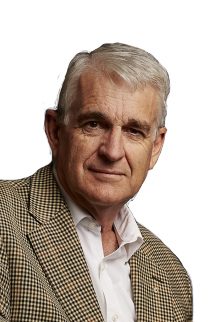
Before John was a podcaster
Dear ,
When I discovered John Anderson media I was struck that such an urbane, intelligent and knowledgeable interviewer had been hidden for so long behind the public image of a successful politician and businessman. But I was even more surprised when I began researching his parliamentary career. They say actions speak louder than words, but not if nobody talks about them. In the great Australian bush tradition, John seems to have been remarkably laconic about his political achievements. So let me blow his trumpet for him. Our Emancipation Day breakfast is on Thursday, 30 July, at Tattersall’s Club, with a 7.00 am arrival for a 7.30 am start. Come and make your own assessment of John. Tickets are $65 for members, $75 for general admission and $60 for students and concession holders. If you haven't booked yet click here.
Elected to Parliament in 1989 at just 32, John was quickly recognised as one of the rising stars of Australian politics. But promise is easy. What distinguished him was his willingness to spend political capital on difficult reforms and accept responsibility for the consequences. After the Howard government’s election in 1996, John became Minister for Primary Industries and Energy. Over the next three years, the government deregulated the wool, wheat and dairy sectors and privatised much of the meat and livestock industry. The gun laws introduced after the Port Arthur massacre must have presented a particular challenge for a minister responsible for primary industries and representing a rural electorate. John was also a member of Peter Costello’s five-man “razor gang”, charged with finding between $6 billion and $8 billion in savings. Across the government’s first two budgets, the fiscal improvement was equivalent to about 4 per cent of total Commonwealth expenditure. Contrast that with Jim Chalmers, under whom expenditure has increased in every full financial year after the initial unwinding of COVID measures. From Primary Industries and Energy, John moved to Transport and Regional Development. During his time in that portfolio, the Australian Rail Track Corporation was established to provide a single point of access to much of the interstate rail network. The commitment to deregulation and efficiency came at a political cost. In 1998, amid internal unrest in the National Party, John and party leader Tim Fischer declared their positions vacant and invited their critics, including Bob Katter, to challenge them. Both were re-elected unopposed. Later that year, private polling in John’s seat of Gwydir reportedly put One Nation on 49 per cent of first preferences. On election day, its vote was 20.8 per cent, not even half that figure, while John was returned with 63.6 per cent after preferences. You might like to ask him what lessons can be drawn from that experience for the present political moment. The abolitionist cause of the eighteenth and nineteenth centuries required foresight, courage, dedication and belief. It reshaped the world in which we live. The politicians who championed it were not superhuman, but they were statesmen who put principle and the future ahead of self-interest and the present. In a different era and under very different circumstances, John has displayed some of those same qualities.
To hear him click here, or if you have booked already, send it to a friend, colleague or relative.
Kind regards,
GRAHAM YOUNG
EXECUTIVE DIRECTOR
AUSTRALIAN INSTITUTE FOR PROGRESS
|