|
Chalmers’ tax changes turbocharge rent – we told you so in 2025
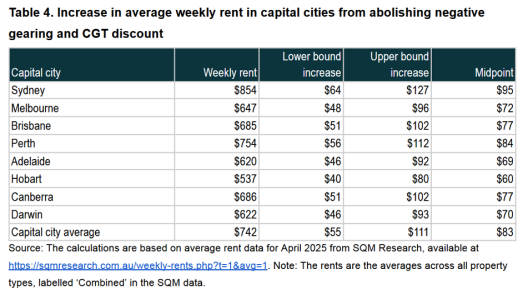
The first rental data since the government announced its tax changes is pointing exactly where we warned it would. Australian Institute for Progress Executive Director Graham Young said “In April 2025 modelling of the Greens proposals, commissioned by us, to abolish the CGT discount and negative gearing, projected long run rises in rents, over and above normal increases, between $60 in Hobart and $95 in Sydney. “In just three months, according to Domain, rents in Sydney are halfway to that figure. Brisbane, with a $20 rise, is almost 25% of the way, and Hobart already 12% of the way, demonstrating that the long run projections, expected to take years, are entirely realistic.” Mr Young said that the figures confirmed the mechanism predicted in their report. According to FoundIt, there were close to 2,159 rental bedrooms added to the Sydney market over May, which was well below the 3,744 rental bedrooms that were lost through sales. “We predicted that reducing the after-tax return from residential investment would shrink rental supply, putting upward pressure on rents. FoundIt’s figures suggest that process has already begun. Mr Young said that journalists and others need to take note of who got their figures wrong. “Treasury should be embarrassed – it claimed a rent rise of only $2 (which was backed by the Commonwealth Bank). “The Australia Institute, the source of many of these bad ideas, ridiculed the notion, floated by industry, that rents could rise $40 a week. “Well industry looks to be more right than wrong – who would have thought the people closest to the market would understand the market better than the boffins? “What is surprising is that in 2024, 20 of the 23 members of Labor's federal cabinet reportedly owned investment property, yet apparently no one around the Cabinet table understood what would happen when government deliberately made rental investment less attractive.” Mr Young said that Australian housing policy was being driven by a number of fantasies and that media and analysts needed to start correcting them. “The claim that the tax system uniquely favours property investors has always ignored the substantial tax advantages enjoyed by owner-occupiers. On their principal residence they generally pay no capital gains tax, no tax on the imputed rental value of their home, and no land tax.” As a home affordability measure the tax changes were misconceived from the start. What counts most is supply and demand, which they fail to address. Mr Young said that he didn’t expect current weakness in house prices to persist. “We’ve seen real decreases in house prices in Canada where they’ve dealt with the demand issue by deliberately and rapidly lowering immigration. “But as the Albanese government refuses to follow Canada, demand in excess of supply will persist here, putting medium and long term upwards pressure on prices. “At the same time the tax changes will lead to fewer houses, which will be exacerbated by the current drop in prices, leading to less supply, and higher prices. “It is worth noting that Canada proposed increasing its capital gains inclusion rate, but Prime Minister and former central banker Mark Carney cancelled the increase, arguing Canada needed to encourage investment. “When Treasury says $2, the market says $50, and rental stock is already disappearing, perhaps it is time the government paid more attention to organisations with a track record of getting these calls right.” For further information contact Graham Young 0411 104 801 or graham.young@aip.asn.au.
|