More expensive rents is not intergenerational equity
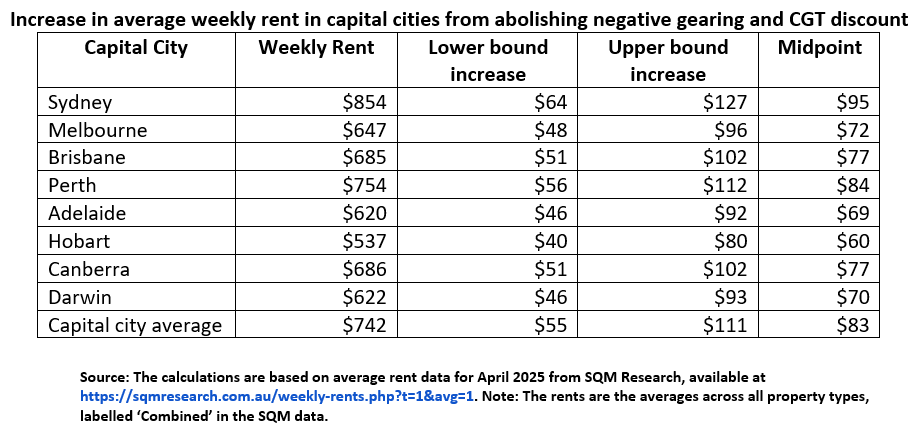
If Jim Chalmers abolishes negative gearing and doubles the capital gains tax as per some proposals it will add $83 a week to average capital city rents on top of normal increases, according to independent modelling released last year by the Australian Institute for Progress.
The modelling, commissioned by the Australian Institute for Progress, predicts many landlords will sell rental properties, reducing their availability, while those that remain will be forced to seek higher rents to compensate for the tax changes.
Graham Young, AIP Executive Director, said that the housing crisis now affects renters more than home owners, many of whom have made handy profits over the last few years. “ABS figures show that rents have increased by 22.29% over the tenure of the Albanese government, significantly higher than the rate of general inflation at 16.1%, and with house prices so high more Australians than ever are locked-out of home ownership and trapped in rentals,’’ Mr Young said. “Renters are the new victims of housing unaffordability. Making it more expensive for purchasers to afford investment properties will only make their plight worse.” The modelling was originally commissioned to cost the Greens' policies with no thought that a re-elected Labor government would break its election promise and go Greens themselves. The modelling calculates the abolition of Negative Gearing and Capital Gains tax concessions will cut the return on investment for rental properties by between 13–16%. The initial short-term impact of the changes could be lower property price appreciation than otherwise in the year it is implemented. “Removing negative gearing and doubling the CGT would result in higher rents over the long term,’’ Adept Economics Director Gene Tunny said. “This is because removing negative gearing and doubling CGT paid would significantly reduce the return on investment in property for investors. “This will likely result in a significant reduction in the supply of rental properties.” Mr Tunny warns significant rent increases could materialise within two years as landlords seek to compensate for higher costs, with the modelling predicting rents could be 11% higher than they would otherwise be. This equated to $60–$95 a week higher in capital cities based on the then current asking rents, with an average of $83 a week. The modelling is almost exactly 12 months old, and rents have risen 6.05% in the meantime, so the figure would be slightly higher now. Given the low vacancy rate in the rental market, the modelling expects the impact of the higher costs created by the abolition of negative gearing and capital gains tax concessions to be passed on through rents more easily than previously.
‘Furthermore, Australia is currently tracking well below the level of dwelling completions necessary to meet the national housing target (ie 240,000 or 60,000 a quarter) meaning there is an even greater challenge to ensure sufficient rental supply in the future.’’ Mr Tunny said some Australians may be better off because the rate of owner occupation may increase. “But those stuck in the rental market would be significantly worse off,’’ he said. For further information contact Graham Young 0411 104 801 or graham.young@aip.asn.au
|