



F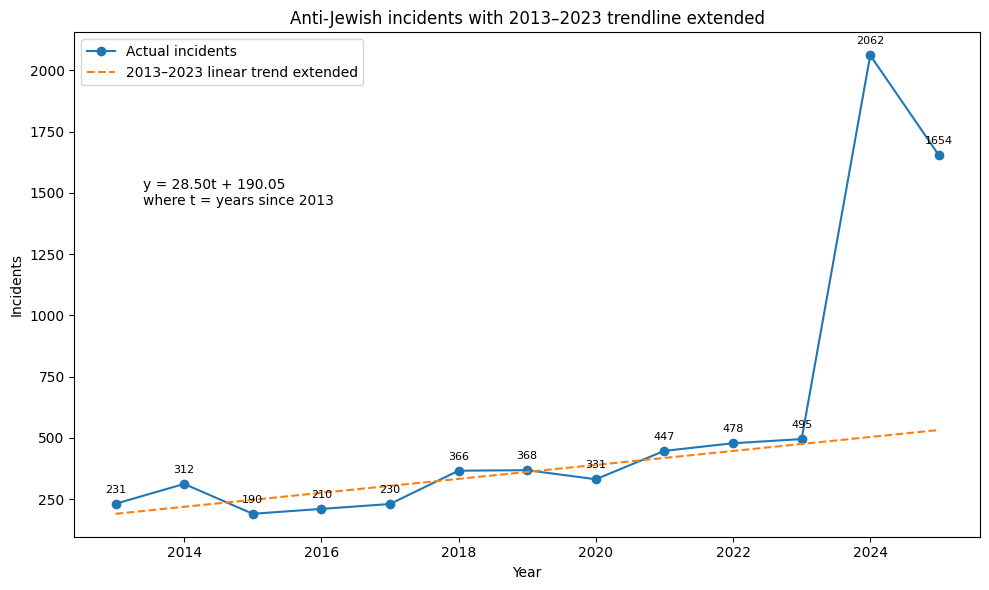 or me, the most shocking thing in modern Australia is the sudden rise in virulent antisemitism. Cancel culture and cultural marxism were shocking enough, but the ultimate in cancellation is antisemitism, so I thought it imperative that we make a submission to the Royal Commission in Antisemitism and Social Cohesion.
When I researched it was worse than I thought. As the graph to the right shows there was a steady increase in antisemitism from 2013 to 2023, then it exploded. The initial gradual creep is more disturbing in some ways than the explosion. The explosion is the work of foreign actors acting through domestic actors and propaganda and is part of Iran’s 50 year war on Israel. It’s not excusable and raises very serious questions of national security, but it is easier to understand than what drove the steady creep.
If the Royal Commission into Antisemitism and Social Cohesion is to do its job properly, it needs to look into both periods to identify the causes of antisemitism, and it also needs to do some work to delineate the the scope of the problem. Our first recommendation was for them to do polling to identify which parts of our community are exhibiting what sorts of antisemitism. Surprisingly no one has done that basic work here, although others have overseas in countries like the UK and France.
Our second and third recommendations deal with a phenomenon called “stochastic terrorism”. This can be defined as “the public demonization of a person or group resulting in the incitement of a violent act, which is statistically probable but whose specifics cannot be predicted”. We are passionately for free speech, but there are limits to free speech. For example the defamation laws are a self-policing limit, while incitement to violence is a limit that the state, via the police force and the courts, should police.
The Bondi Beach massacre itself is arguably an example of stochastic terrorism in that the terrorists appear to have had only tenuous, if any, links directly to terrorist organisations, so there was no chain of command, but there was an indirect command, and normalisation of the activity, via the propaganda spewed by terrorist organisations and other individuals and groups. Nothing could be more powerful in this area than street marches with 1,000s of people shouting “Globalise the Intifada”, and “From the River to the Sea, Palestine will be free”.
Obviously one cannot police all such speech, but the organised propagation of it, amplified by news broadcasts is another matter. Queensland has criminalised the use of both of these phrases, and in the current circumstances that appears reasonable. The question then is, will the police, and the courts, prosecute and uphold these sorts of laws. Our second recommendation is for judicial education about this sort of terrorism. It would be ironic if the High Court’s discovery of an implied right to political freedom (which cannot be overturned by any legislature) were allowed to pull the trigger on more antisemitic acts of violence because the judges didn’t understand how stochastic terrorism works.
Our third recommendation allowed that it might be necessary to forbid the use of certain terms that might incite violence, but that the standard ought to be that of the reasonable member of the community, not as it is in most hate crimes legislation, that of a person who is a member of the group alleged to be offended.
We also don’t believe that it is the role of social media companies to police speech (as the eSafety Commisssioner has just argued to the Commission). That is the role of police and other security agencies, and to some extent, forcing social media companies to judge what ought to be removed, and to remove it, hampers law enforcement in its role.
While Australia has become more antisemitic over the last decade or so (and a number of other countries even more so), there are bright spots. Sweden, for example, has decreased its rate of antisemitism, and we recommend the Commission should investigate how it did this.
We also recommend a national Holocaust Remembrance Day. This day shouldn’t just be about the Jewish Holocaust, but also about the contribution to our culture of Judaism itself, and the many Jews who have made prominent contributions to Western culture and Australian life. In our submission we ask the question “Why the Jews?”. Part of the answer to that question is because they have been prepared to assert their identity no matter what and insist on their version of the truth. Another part is that we live in a culture increasingly looked to shift blame from individuals to others factors such as the system, or even “oppressors”. A Holocaust Day Remembrance could be a day to celebrate, in opposition to such relativism and blame shifting, the few who have stood against the crowd.
To read the submission click here.